Privacy-Preserving Transformer-Based Eating Detection and Caloric Modeling from Wearable Camera
Published in npj Digital Medicine (In Submission), 2026
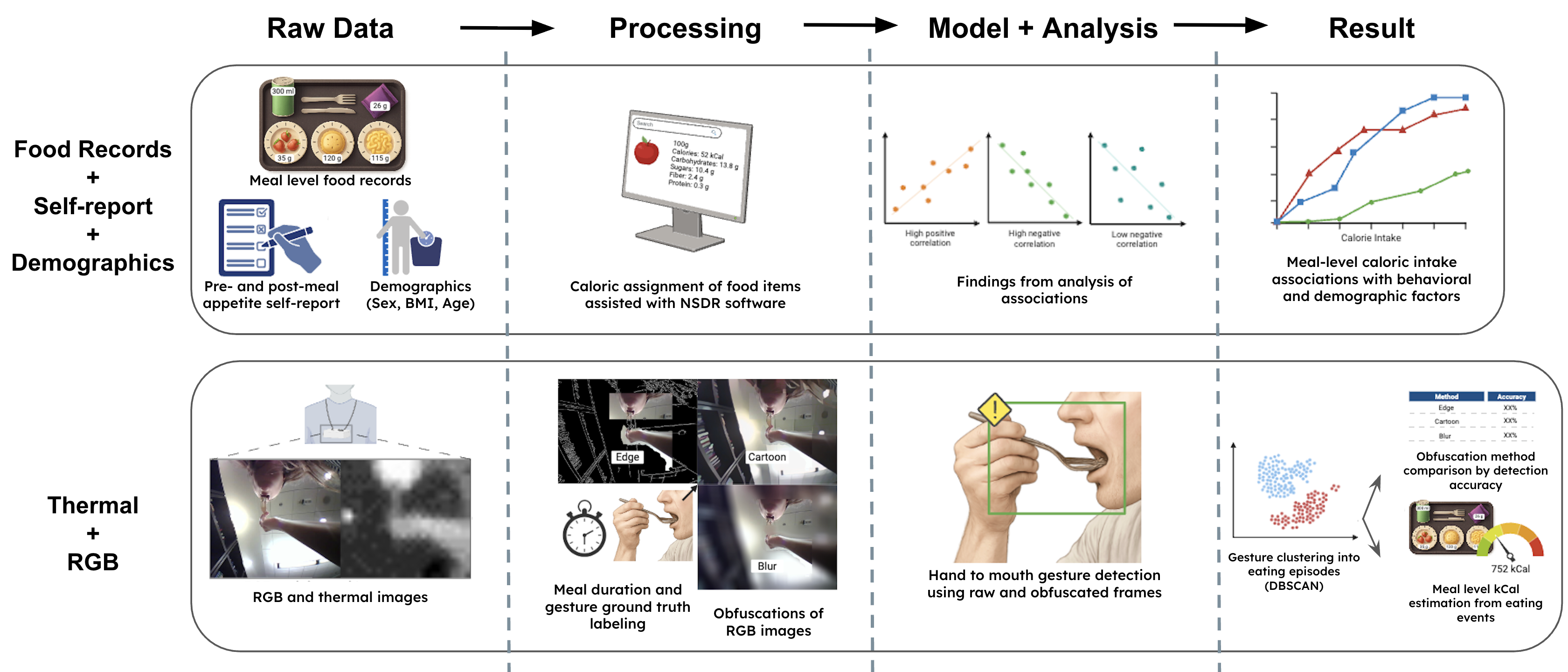
Summary: We evaluate whether privacy-preserving visual obfuscation (cartoon, blur, edge) maintains the performance of automated eating detection and caloric estimation from wearable camera data.
Abstract
We investigate the impact of privacy-preserving visual obfuscation on automated eating detection and caloric estimation using wearable camera data. Using a dataset collected from 59 participants in a controlled, full-day observational study, we compare three obfuscation techniques (cartoon, blur, edge) against raw RGB imagery for detecting hand-to-mouth (H2M) gestures with a TimeSformer-based model.
Cartoon obfuscation achieves near-equivalent performance to raw video, with an average F1 score of 0.830 compared to 0.844 for RGB, representing only a 4.8% reduction in true positive detections. We further demonstrate that gesture-derived features strongly predict meal-level caloric intake in both controlled and free-living settings using mixed-effects regression models.
Our results show that privacy-preserving transformations can retain critical behavioral signals required for both fine-grained gesture recognition and downstream health inference, supporting the feasibility of deploying wearable camera systems for scalable, real-world dietary monitoring.