Generative AI Cartooning for Privacy-Preserving Eating Context Analysis from Wearable Camera Footage
Published in IEEE Engineering in Medicine and Biology Conference (EMBC), 2026
Summary: We study whether generative AI–based cartoon obfuscation preserves the ability to recognize key eating contexts from wearable camera data while protecting privacy.
Abstract
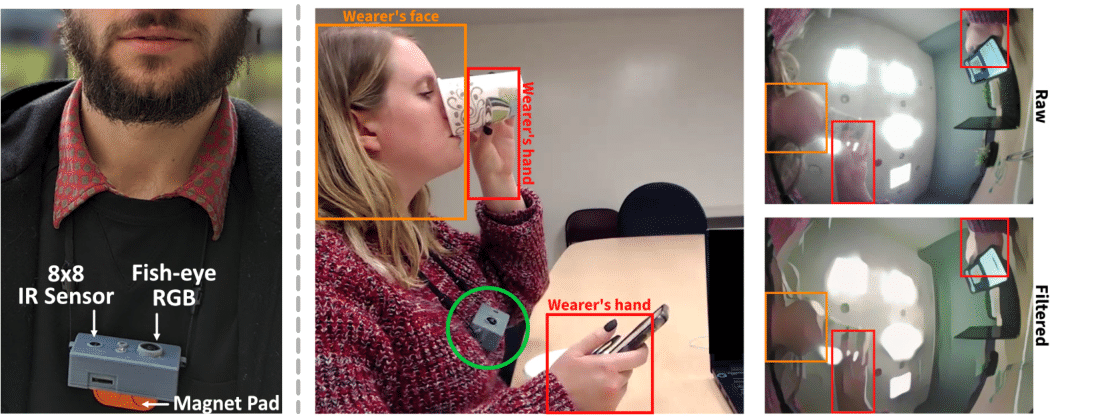
We investigate the trade-off between privacy preservation and contextual utility in wearable camera–based eating behavior analysis using generative AI cartoonization. Leveraging a free-living dataset of over 1,000 hours of egocentric video, we annotate key eating contexts (bystander presence, restaurant setting, and screen use) and evaluate recognition performance under raw and cartoon-obfuscated conditions.
We apply a GAN-based cartoonization pipeline that removes identity-sensitive details while preserving activity-relevant visual structure. Through a large-scale online study (n=196) and statistical analysis using generalized linear mixed-effects models (GLMMs) within a non-inferiority testing framework, we show that cartoon-obfuscated videos achieve comparable performance to raw footage across multiple contexts, with minimal degradation in accuracy.
Our results demonstrate that privacy-preserving transformations can retain critical behavioral context for downstream health sensing tasks, enabling scalable deployment of wearable cameras for real-world eating behavior monitoring and intervention design.