Interaction- and Geometry-Aware Domain Adaptation for Label-Efficient Device-Free Multi-Target Localization Using Wi-Fi CSI
Published in Engineering Applications of Artificial Intelligence (In Submission), 2026
Summary: We present IGDA-MultiLoc, an interaction- and geometry-aware domain-adaptation framework for label-efficient, device-free multi-target localization using Wi-Fi CSI.
Abstract
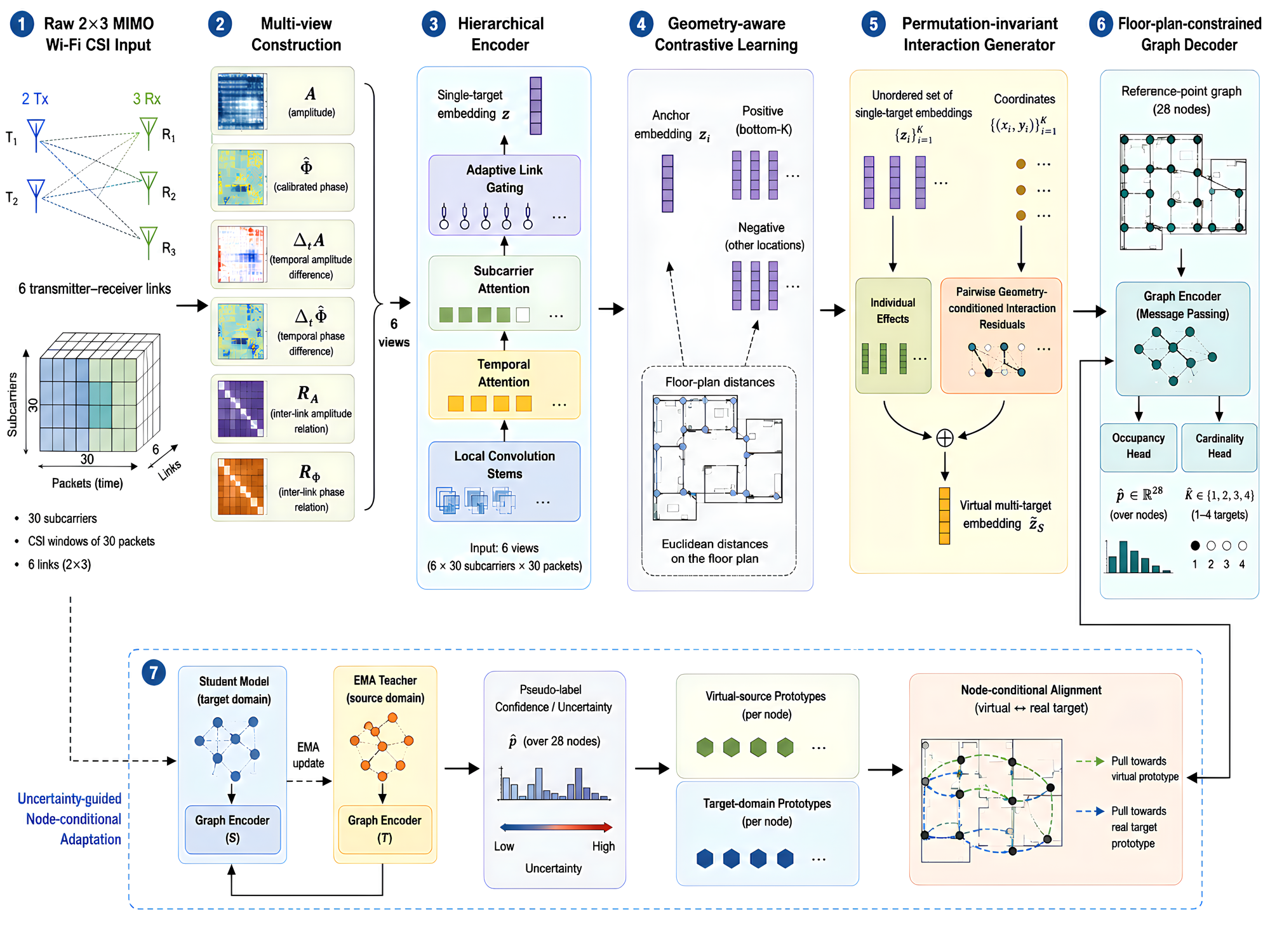
Device-free multi-target localization based on Wi-Fi channel state information (CSI) is hindered by three challenges: structured dependencies across time, frequency, and antenna links; nonlinear interactions among multiple occupants; and the high cost of collecting labeled fingerprints for all possible multi-target configurations. This paper proposes IGDA-MultiLoc, an interaction- and geometry-aware domain-adaptation framework trained using labeled single-target CSI and unlabeled real multi-target observations.
A hierarchical multi-view encoder jointly models denoised amplitude, calibrated phase, temporal differences, and inter-link relations. Geometry-aware contrastive learning organizes the latent representation according to floor-plan-constrained distances between reference points. A permutation-invariant interaction generator constructs virtual multi-target representations by separating individual propagation effects from transmitter-receiver-geometry-conditioned interaction residuals. A floor-plan-constrained graph decoder jointly estimates occupied reference points and target cardinality, while uncertainty-weighted node-conditional adaptation aligns virtual and real target-domain features.
Experiments conducted over five days in an approximately 100 m² laboratory with 28 reference points and two to four simultaneous occupants yielded an Optimal Subpattern Assignment error of 0.420 m, a target-count accuracy of 88.7%, a macro-F1 score of 89.4%, and a node-level expected calibration error of 0.047. The complete processing pipeline required 25.9 ms after CSI-window acquisition and supported a localization update rate of approximately 10 Hz.