Wearable Thermal Sensing for Real-Time Smoking and Eating Activity Detection: A Confirm-Refute Study
Published in Journal of Medical Internet Research (JMIR) (In Submission), 2026
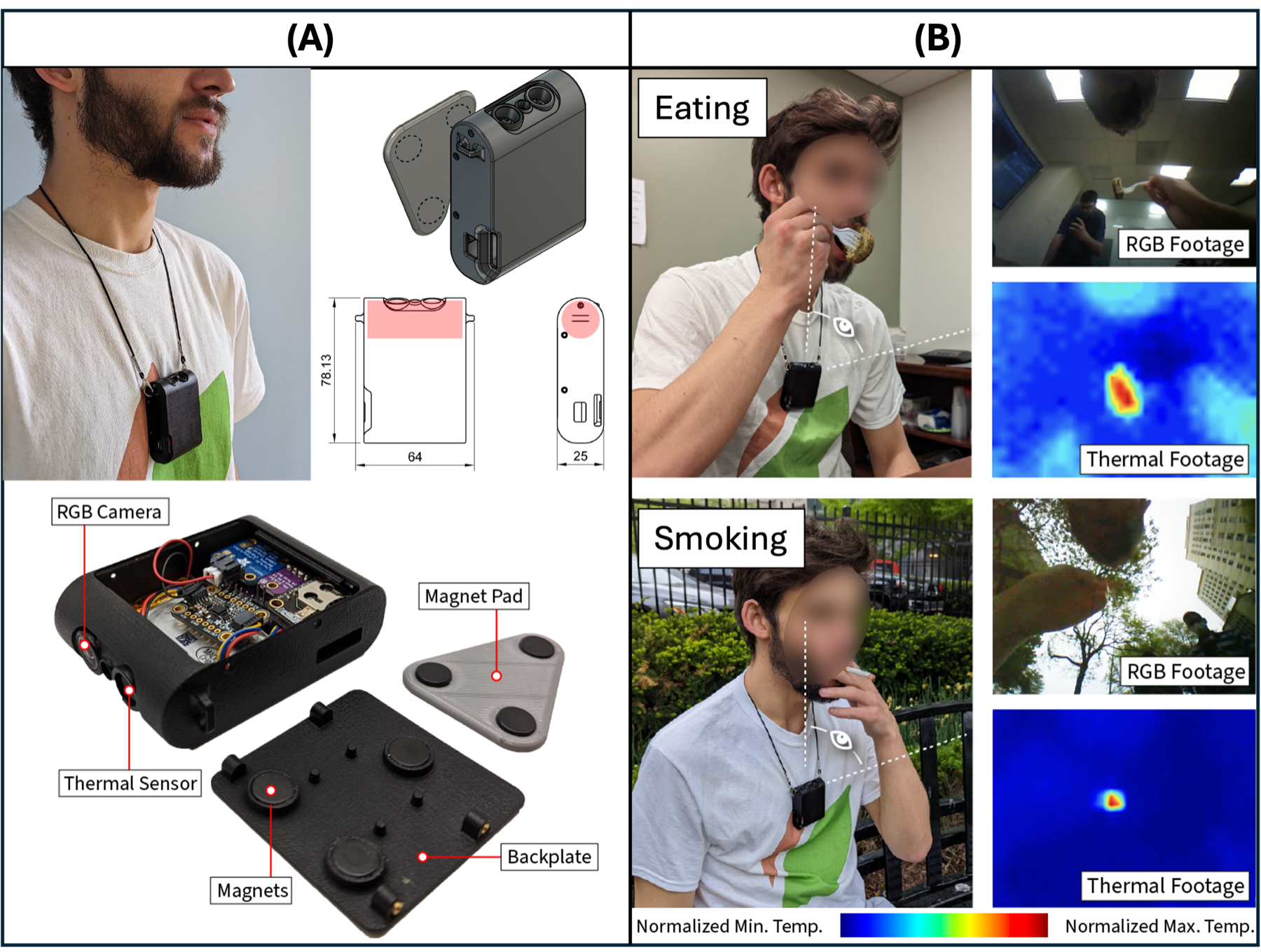
Summary: We evaluate HabitSense, a wearable thermal-RGB sensing system that detects smoking and eating events in real time and triggers smartwatch-based confirm-refute ecological momentary assessments.
Abstract
Background: Smoking and overeating are repetitive hand-to-mouth behaviors that contribute to highly prevalent yet preventable diseases. Leveraging this shared behavioral pattern, we developed HabitSense, a wearable system that integrates thermal sensors, a privacy-conscious camera, and on-device algorithms to detect smoking and eating events in real time and trigger a paired smartwatch to collect contextual data using ecological momentary assessment (EMA). Most existing wearable systems have not been validated in free-living conditions to detect these behaviors in real time. We evaluated the detection accuracy of HabitSense in a free-living user study.
Methods: Seventeen participants (9 in the smoking cohort and 8 in the eating cohort) wore HabitSense, a custom necklace paired with a smartwatch, during waking hours for 7 consecutive days. Two separate machine-learned algorithms processed data from the thermal sensor array and camera on-device. When HabitSense predicted a smoking or eating event, the smartwatch prompted a micro-EMA asking the participant to confirm or refute the prediction. An integrated camera recorded video to enable visual confirmation of each predicted smoking and eating event.
Results: In total, 780.6 hours of sensor data were collected, capturing 217 smoking episodes and 87 eating episodes. The necklace generated 229 smoking-event predictions, of which 209 (91%) were true positives and 20 (9%) were false positives. Eight undetected smoking episodes were identified through manual review of the video footage. Participants responded to 212 EMA smoking-event prompts (92.6%); of these responses, 206 (97.2%) were correct. The necklace also generated 84 eating-event predictions, of which 67 (79.8%) were true positives and 17 (20.2%) were false positives. Twenty undetected meals were identified in video footage.
Conclusions: HabitSense demonstrated high accuracy in smoking detection and strong response rates to smoking-triggered EMAs, supporting its potential for real-time behavioral assessment in free-living settings. For eating detection, the variability and complexity of food-related behaviors indicate that more advanced machine-learning approaches may be required, particularly for deployment on highly resource-constrained wearable devices. This work supports a personalized, adaptive intervention system that accounts for individual differences in behavior.